

Key Takeaways
Pancreatitis can disrupt digestion and change the conditions that normally help regulate bacteria in the small intestine.
People with chronic pancreatitis have a higher likelihood of developing SIBO.
Because pancreatitis and SIBO share symptoms, identifying both conditions may be important when digestive problems persist.
The pancreas plays an important role in digestion, producing enzymes that help break down food in the small intestine. When the pancreas becomes inflamed, a condition known as pancreatitis, these digestive functions can be disrupted. Research suggests that pancreatitis, particularly chronic pancreatitis, may increase the likelihood of small intestinal bacterial overgrowth (SIBO).
Because SIBO and pancreatitis share symptoms, including abdominal pain, bloating, diarrhea, and difficulty absorbing nutrients, understanding this connection may help explain why some people with pancreatitis continue to experience digestive problems despite treatment.
What Is Pancreatitis?
Pancreatitis occurs when the pancreas becomes inflamed. The pancreas is an organ located behind the stomach. The pancreas produces digestive enzymes that help break down food and hormones, including insulin, that regulate blood sugar.
Gallstones and heavy alcohol use are the most common causes. Pancreatitis can also result from certain medications, very high triglyceride levels (a type of fat in the blood), genetic conditions, and other factors.
There are two main types:
Acute pancreatitis develops suddenly and can cause severe abdominal pain, nausea, and vomiting. Many people recover, but severe cases can lead to serious complications.
Chronic pancreatitis involves ongoing inflammation that gradually damages the pancreas. Over time, this can interfere with digestion and blood sugar regulation.
One common complication of chronic pancreatitis is exocrine pancreatic insufficiency (EPI), which occurs when the pancreas does not produce enough digestive enzymes to properly break down food. EPI can cause diarrhea, bloating, weight loss, and difficulty absorbing nutrients.
How Are Pancreatitis and SIBO Connected?
The pancreas does more than help digest food. Its secretions also help maintain the environment of the small intestine and regulate the bacteria that live there.
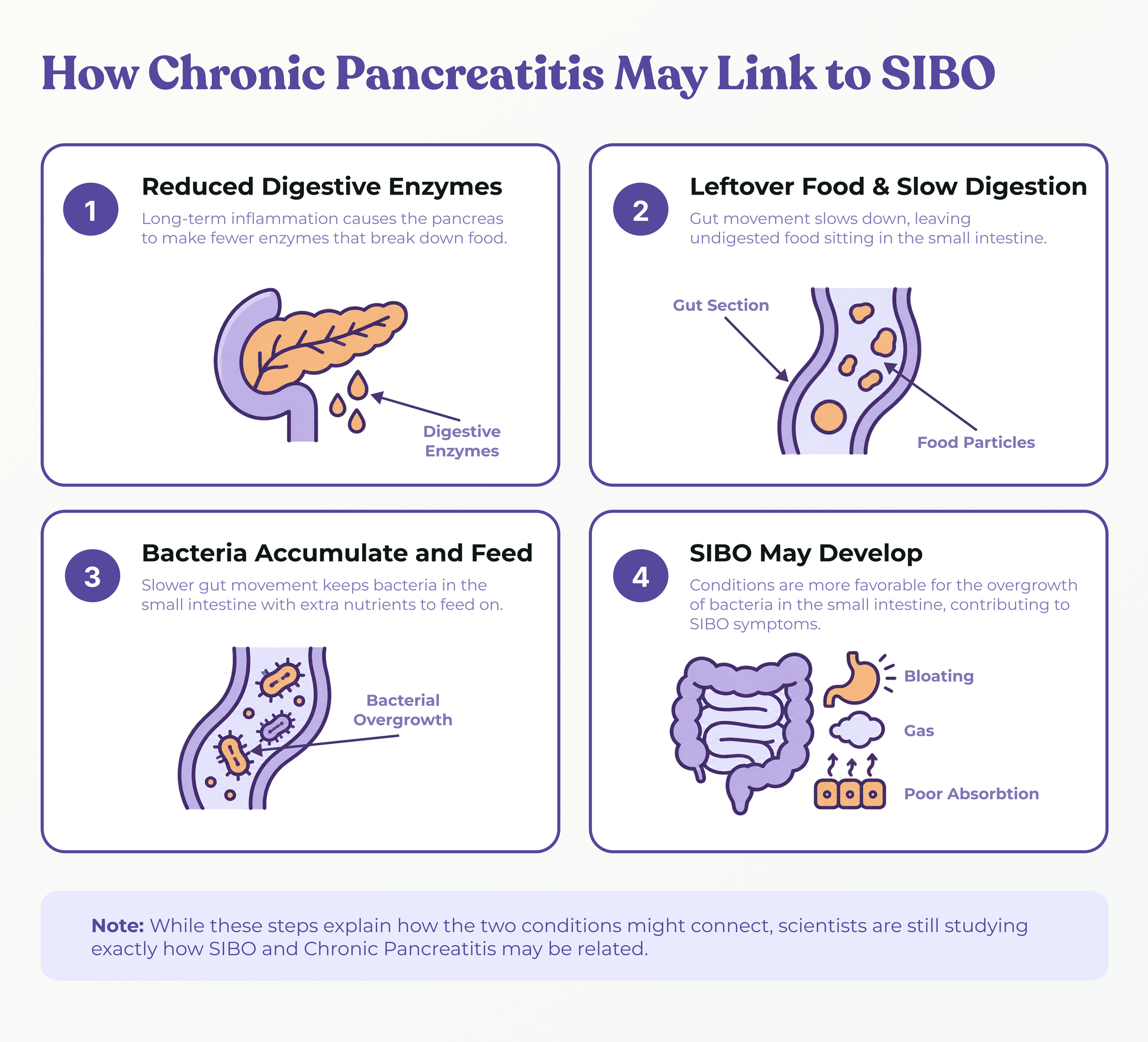
Pancreatitis may increase the likelihood of SIBO through several mechanisms:
Reduced pancreatic secretions: Pancreatic fluids contain substances that help control intestinal bacteria. When these secretions are disrupted, the balance of bacteria in the small intestine may change.
Slower intestinal movement: Pancreatitis, particularly during severe acute episodes, can interfere with the normal movement of food and waste through the intestines. Slower movement may allow bacteria to accumulate.
Impaired digestion: When the pancreas produces fewer digestive enzymes, food may not be fully broken down and absorbed. This can change the nutrients available to intestinal bacteria and may contribute to microbial imbalances.
Together, these changes may create conditions that favor bacterial overgrowth, although researchers are still investigating the precise mechanisms.
What Does the Research Tell Us?
Chronic Pancreatitis and SIBO
Research has identified a significant association between chronic pancreatitis and SIBO. For example, a systematic review found that approximately 39% of people with chronic pancreatitis had SIBO, and that people with chronic pancreatitis had substantially higher odds of SIBO than those without the condition.
SIBO was also more common among patients with exocrine pancreatic insufficiency or diabetes, two complications of chronic pancreatitis. However, prevalence estimates varied considerably across studies, partly because researchers used different methods to diagnose SIBO.
Other research suggests that chronic pancreatitis can affect the broader gut microbiome, leading to lower microbial diversity and higher levels of certain potentially harmful bacteria. Changes in the intestinal microbial environment, therefore, may also create conditions that allow SIBO to develop in people with chronic pancreatitis
Acute Pancreatitis and SIBO
Emerging research suggests that SIBO may also occur during acute pancreatitis, particularly in more severe cases.
One recent study found that 40% of patients with acute pancreatitis tested positive for SIBO, compared with fewer than 2% of healthy participants. Findings suggest changes in intestinal movement and other digestive disruptions may contribute to bacterial overgrowth.
Studies in this area are limited and further research is needed to determine how common SIBO is during acute pancreatitis and whether treating it improves patient outcomes.
Why Does This Connection Matter?
Pancreatitis and SIBO can cause similar digestive symptoms, making it difficult to determine which condition is responsible for ongoing discomfort. This overlap is particularly important for people with chronic pancreatitis who develop EPI.
EPI is commonly treated with pancreatic enzyme replacement therapy, which helps the body digest food. However, this treatment does not directly address SIBO, which means patients could continue to have the same symptoms due to a different problem.
Recognizing the connection between pancreatitis and SIBO can support a more comprehensive evaluation of persistent digestive symptoms and help ensure that each condition receives appropriate treatment.
References
Beyer, G., Habtezion, A., Werner, J., Lerch, M. M., & Mayerle, J. (2020). Chronic pancreatitis. The Lancet, 396(10249), 499–512. https://doi.org/10.1016/S0140-6736(20)31318-0
Cleveland Clinic. (2026, August 12). Pancreatitis. https://my.clevelandclinic.org/health/diseases/8103-pancreatitis
El Kurdi, B., Babar, S., El Iskandarani, M., Bataineh, A., Lerch, M. M., Young, M., & Singh, V. P. (2019). Factors that affect prevalence of small intestinal bacterial overgrowth in chronic pancreatitis: A systematic review, meta-analysis, and meta-regression. Clinical and Translational Gastroenterology, 10(9), e00072. https://doi.org/10.14309/ctg.0000000000000072
Frost, F., Weiss, F. U., Sendler, M., Kacprowski, T., Rühlemann, M., Bang, C., Franke, A., Völker, U., Völzke, H., Lamprecht, G., Mayerle, J., Aghdassi, A. A., Homuth, G., & Lerch, M. M. (2020). The gut microbiome in patients with chronic pancreatitis is characterized by significant dysbiosis and overgrowth by opportunistic pathogens. Clinical and Translational Gastroenterology, 11(9), e00232. https://doi.org/10.14309/ctg.0000000000000232
Kumbar, C., Vaithiyam, V., Reddy, R. T., Mehta, K., Ahuja, A., Kumar, A., Dalal, A., & Sachdeva, S. (2026). Frequency and predictors of small intestinal bacterial overgrowth in acute pancreatitis. World Journal of Gastrointestinal Pharmacology and Therapeutics, 17(2), 118784. https://doi.org/10.4292/wjgpt.v17.i2.118784