

Key Takeaways
Acid reflux occurs when stomach contents flow backward into the esophagus. It is not necessarily caused by producing too much stomach acid.
Silent reflux can affect the throat and voice box without causing heartburn.
Acid reflux and silent reflux share underlying mechanisms, but their symptoms and treatment approaches can differ.
Emerging research suggests that SIBO and intestinal gas production may contribute to reflux symptoms, particularly belching and regurgitation, although a direct causal relationship has not been established.
Acid reflux is often associated with heartburn, a burning sensation in the chest that occurs when stomach contents flow backward into the esophagus. But not everyone who experiences reflux has heartburn. Some people instead experience a persistent cough, frequent throat clearing, hoarseness, or the sensation of something stuck in their throat. These symptoms are sometimes associated with a condition known as silent reflux.
Understanding why reflux happens, what makes silent reflux different, and how other digestive conditions may contribute can help people recognize symptoms and explore appropriate treatment options.
What Is Acid Reflux, and Why Does It Happen?
Normally, food travels down the esophagus and into the stomach. A ring of muscle called the lower esophageal sphincter (LES) acts like a valve between the esophagus and stomach, helping prevent stomach contents from flowing backward.
This valve normally opens when we swallow or belch. Belching allows gas to escape from the stomach, but sometimes stomach contents can travel upward along with the gas, causing reflux. The valve can also relax at other times, particularly when the stomach stretches after a large meal. If it opens too often or does not close tightly enough, stomach contents can flow backward into the esophagus.
Because these contents may include stomach acid and digestive enzymes, repeated exposure can irritate the esophageal lining, leading to reflux.
Occasional acid reflux is common, but when reflux causes troublesome symptoms or leads to complications, it may be diagnosed as gastroesophageal reflux disease (GERD). GERD commonly causes heartburn and regurgitation, although not everyone experiences these symptoms.
Importantly, reflux is not necessarily caused by excessive stomach acid. Problems with the barrier between the stomach and esophagus, delayed stomach emptying, and increased sensitivity to reflux can all influence symptoms.
What Is Silent Reflux?
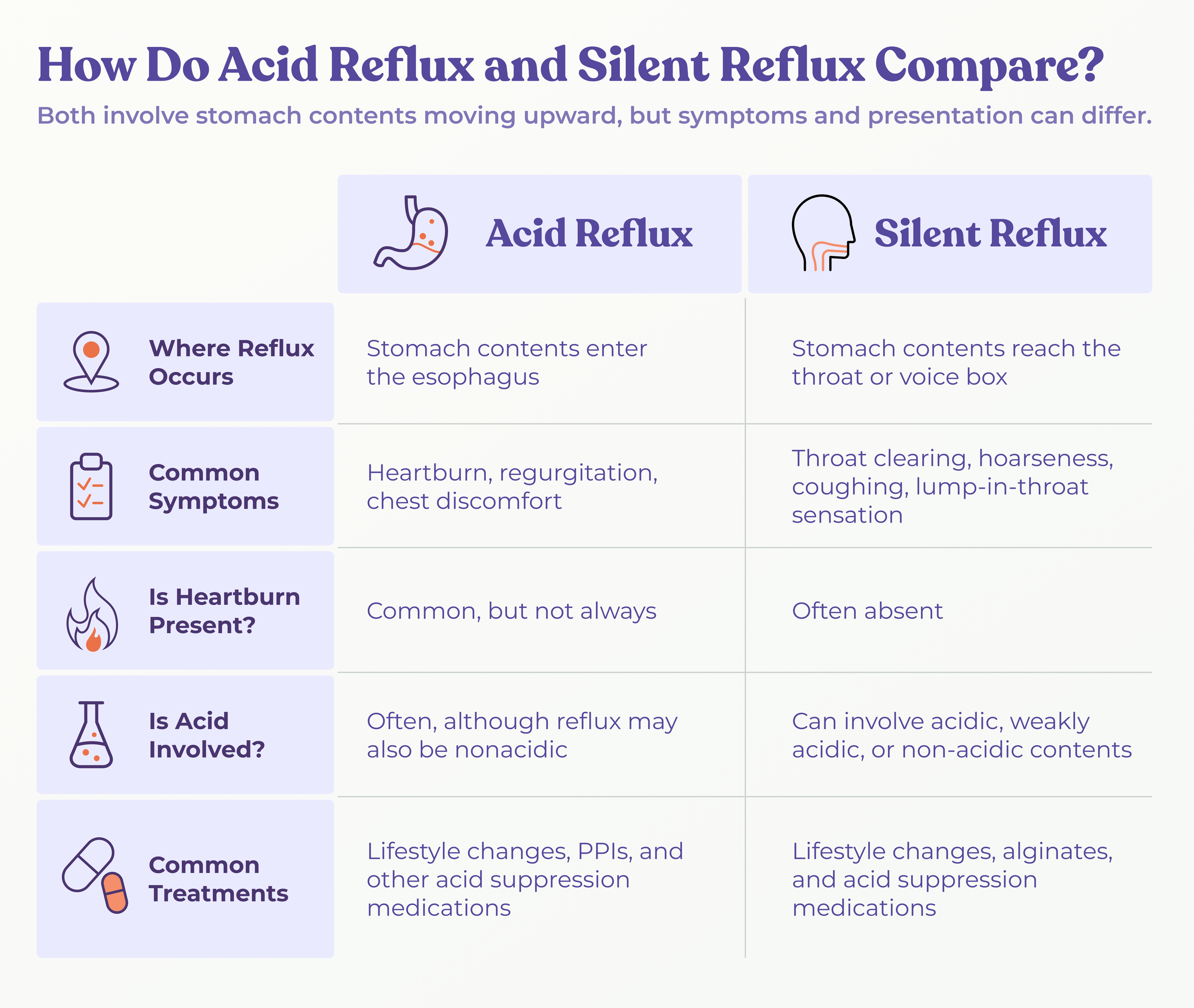
Silent reflux, also called laryngopharyngeal reflux (LPR), occurs when stomach contents travel beyond the esophagus and reach the throat or voice box.
Both acid reflux and silent reflux involve stomach contents moving backward, but they differ in where those contents travel and the symptoms they may cause. Both can involve acidic or nonacidic stomach contents.
Unlike typical acid reflux, which commonly causes heartburn, silent reflux may produce symptoms such as:
Frequent throat clearing or a persistent cough
Hoarseness or changes in the voice
A sensation of a lump in the throat, known as globus
Excess mucus or throat irritation
Difficulty swallowing or persistent throat discomfort
These symptoms may occur without heartburn, which is why LPR is often called silent reflux. The throat and voice box are particularly sensitive to exposure to stomach contents, including digestive enzymes such as pepsin.
However, diagnosing silent reflux can be challenging. Many of its symptoms can also result from allergies, respiratory conditions, or other throat disorders. Clinical guidelines emphasize that symptoms alone cannot confirm LPR, and additional testing may be needed.
GERD and LPR can coexist, but having one does not necessarily mean having the other. GERD mainly involves the esophagus, while LPR involves the throat and voice box.
What Causes Reflux?
Several factors can contribute to reflux. Some increase the likelihood of stomach contents moving backward, while others may trigger or worsen symptoms.
Everyday factors that may trigger or worsen reflux include:
Eating patterns: Large meals can stretch the stomach, triggering the valve between the stomach and esophagus to open and allowing reflux to occur. Lying down soon after eating can also increase reflux.
Certain foods and beverages: Fatty meals, acidic or spicy meals, alcohol, coffee, and other foods may trigger symptoms in some people, although individual responses vary.
Smoking: Tobacco use can interfere with normal esophageal function.
Abdominal pressure: Increased pressure around the stomach, including from excess body weight, can promote reflux.
Underlying medical conditions may also contribute:.
Gastroparesis: Delayed stomach emptying may contribute to stomach distension and reflux in some people.
Conditions affecting digestive muscles and nerves: Certain disorders can interfere with the valve between the stomach and esophagus or the muscular movements that help clear refluxed contents.
These conditions can affect reflux through different mechanisms, making it important to understand the underlying causes rather than focusing only on symptoms.
Can SIBO Contribute to Reflux?
Researchers are increasingly investigating whether small intestinal bacterial overgrowth (SIBO) may contribute to acid reflux and silent reflux symptoms.
SIBO occurs when excessive bacteria in the small intestine break down carbohydrates through fermentation, producing gases that can cause bloating and digestive discomfort. Researchers believe this increased gas production may also contribute to reflux by affecting pressure and movement in the digestive tract, potentially allowing stomach contents to flow backward into the esophagus. However, the exact relationship remains unclear.
Several studies provide evidence of a possible connection between SIBO and reflux, finding that:
SIBO may be more common in people with reflux. In two hospital studies from China, people with reflux were more likely to test positive for SIBO than people without it, although neither study could show which condition came first.
SIBO may be associated with more gas-related reflux symptoms. Patients with SIBO or intestinal methanogen overgrowth (IMO) reported more bloating and belching, and those with SIBO more often had regurgitation that coincided with reflux events, even though they did not have significantly more reflux episodes or greater acid exposure.
SIBO may be linked to more severe silent reflux symptoms. Patients with SIBO reported more severe throat-related symptoms, although testing did not show significantly greater acid exposure or more frequent reflux episodes.
Treating intestinal overgrowth may improve reflux symptoms. Patients with SIBO or IMO reported improvements in reflux and throat-related symptoms after receiving antibiotics followed by a low-FODMAP diet. However, the study could not determine whether the improvements resulted from antibiotics, dietary changes, or both.
Together, these findings suggest that SIBO and intestinal fermentation may contribute to reflux symptoms in some people, particularly those experiencing bloating, belching, and regurgitation. However, researchers have not yet established whether SIBO directly contributes to reflux, makes existing symptoms worse, or shares underlying causes with reflux conditions.
How Are Acid Reflux and Silent Reflux Managed?
Treatment depends on the underlying causes and severity of symptoms. Some approaches may help both acid reflux and silent reflux, while others depend on the type of reflux involved.
Lifestyle adjustments, such as eating smaller meals, avoiding lying down soon after eating, and identifying individual food triggers, may help reduce symptoms. For silent reflux, clinical guidelines also recommend alginates, which form a barrier to help prevent reflux.
Proton pump inhibitors (PPIs) reduce stomach acid and are commonly used to treat GERD. However, they may be less effective for silent reflux, particularly when symptoms are not caused by acid. Research also suggests that PPIs can change the gut microbiome and are associated with an increased likelihood of SIBO, possibly because lower stomach acid allows more bacteria to survive. PPIs remain an important treatment for GERD and should be used under medical guidance.
For people experiencing persistent throat symptoms without heartburn, medical evaluation may be particularly important. Because these symptoms can have several possible causes, determining whether reflux is responsible can help guide appropriate treatment.
The Bottom Line
Acid reflux is more complicated than excess stomach acid, and heartburn is only one possible symptom. Silent reflux can affect the throat and voice box without causing heartburn. Emerging research also suggests that SIBO and intestinal gas production may contribute to reflux symptoms in some people.
Although researchers are still working to understand these connections, recognizing the different factors that contribute to reflux can help patients and healthcare providers identify underlying causes and explore appropriate treatment options.
Key References
Chidambaram, S., et al. (2025). Treatment of oesophageal and laryngo-pharyngeal symptoms of reflux in patients diagnosed with SIBO and IMO with antibiotics. Diseases of the Esophagus, 38. https://doi.org/10.1093/dote/doaf001
Guo, H., Ma, H., & Wang, J. (2016). Proton pump inhibitor therapy for the treatment of laryngopharyngeal reflux: A meta-analysis of randomized controlled trials. Journal of Clinical Gastroenterology, 50(4), 295–300. https://doi.org/10.1097/MCG.0000000000000324
Haworth, J. J., Boyle, N., Vales, A., & Hobson, A. R. (2021). The prevalence of intestinal dysbiosis in patients referred for antireflux surgery. Surgical Endoscopy, 35(12), 7112–7119. https://doi.org/10.1007/s00464-020-08229-5
Haworth, J. J., Otterstad, M., Birchall, M. A., & Hobson, A. R. (2023). Small intestinal bacterial overgrowth is associated with laryngopharyngeal reflux symptom severity and impaired esophageal mucosal integrity. Gastrointestinal Tract, 1(10). https://doi.org/10.54844/git.2023.459
Hu, Z., Shan, B., Wang, Y., et al. (2025). Association of gastroesophageal reflux disease with small intestinal bacterial overgrowth: A case-control study. BMC Gastroenterology, 25, 753. https://doi.org/10.1186/s12876-025-04291-2
Jackson, M. A., et al. (2016). Proton pump inhibitors alter the composition of the gut microbiota. Gut, 65(5), 749–756. https://doi.org/10.1136/gutjnl-2015-310861
Kahrilas, P. J., et al. (2025). Review article: Individualised management of reflux-like symptoms—Strategies beyond acid suppression. Alimentary Pharmacology & Therapeutics, 61, 1437–1446. https://doi.org/10.1111/apt.70115
Katz, P. O., Dunbar, K. B., Schnoll-Sussman, F. H., Greer, K. B., Yadlapati, R., & Spechler, S. J. (2022). ACG clinical guideline: Diagnosis and management of gastroesophageal reflux disease. American Journal of Gastroenterology, 117(1), 27–56. https://doi.org/10.14309/ajg.0000000000001538
Lechien, J. R., et al. (2019). Evaluation and management of laryngopharyngeal reflux disease: State of the art review. Otolaryngology–Head and Neck Surgery, 160(5), 762–782. https://doi.org/10.1177/0194599819827488
Lechien, J. R., et al. (2026). European clinical practice guideline: Managing and treating laryngopharyngeal reflux disease. European Archives of Oto-Rhino-Laryngology, 283, 629–641. https://doi.org/10.1007/s00405-024-09181-z
Lombardo, L., Foti, M., Ruggia, O., & Chiecchio, A. (2010). Increased incidence of small intestinal bacterial overgrowth during proton pump inhibitor therapy. Clinical Gastroenterology and Hepatology, 8(6), 504–508. https://doi.org/10.1016/j.cgh.2009.12.022
Quigley, E. M. M. (2025). Impacts of intestinal fermentation on gastroesophageal reflux disease: Can the tail wag the dog? Diseases of the Esophagus, 38. https://doi.org/10.1093/dote/doae105
Sawada, A., Sifrim, D., & Fujiwara, Y. (2023). Esophageal reflux hypersensitivity: A comprehensive review. Gut and Liver, 17, 831–842. https://doi.org/10.5009/gnl220373
Sharabi, E., & Rezaie, A. (2024). Small intestinal bacterial overgrowth. Current Infectious Disease Reports, 26, 227–233. https://doi.org/10.1007/s11908-024-00847-7
Wang, Z.-T., et al. (2025). Correlation between gastroesophageal reflux disease and small intestinal bacterial overgrowth: Analysis of intestinal microbiome and metabolic characteristics. Journal of Inflammation Research, 18, 33–51. https://doi.org/10.2147/JIR.S487185
Yadlapati, R., et al. (2026). The San Diego consensus for laryngopharyngeal symptoms and laryngopharyngeal reflux disease. American Journal of Gastroenterology, 121(2), 322–336. https://doi.org/10.14309/ajg.0000000000003482