
Which SIBO Diet is Which? How the Low FODMAP, Low Fermentation, and Bi-Phasic Diets Compare

Different diets for SIBO work for different people.
Key Takeaways
There is no single “SIBO diet.” Several dietary approaches are used because they are based on different principles and were developed to address different aspects of digestive symptoms.
The Low FODMAP Diet, Low Fermentation Eating, and the Bi-Phasic Diet share many similarities but differ in how they approach reducing fermentation and managing symptoms.
Dietary changes are generally intended to help manage symptoms and support treatment, not cure SIBO or permanently eliminate foods.
The long-term goal of any dietary approach should be to return to the most varied, nutritious diet that you can comfortably tolerate.
Why Are There Different Diets for SIBO?
If you have been diagnosed with small intestinal bacterial overgrowth (SIBO), one of the first questions you may ask is, “What diet should I follow?” A quick online search often leads to several different answers and various options. Three diets commonly recommended include: the Low FODMAP Diet, Low Fermentation Eating, and the Bi-Phasic Diet along with many others.
One reason there are many approaches relates to the fact that SIBO is not a single, uniform condition. People develop SIBO for different reasons, experience different symptoms, and vary in the foods they tolerate. The microbes involved may also differ from person to person. Because of this complexity, dietary management is rarely one-size-fits-all.
The three dietary approaches discussed in this article were developed from different perspectives, but they all share a common goal: helping reduce symptoms by limiting excessive fermentation in the small intestine while supporting overall nutrition. These approaches represent different ways of thinking about how food influences digestive symptoms.
This article explains the guiding principles behind each approach, how they compare, and what current research tells us about their role in SIBO management. Because each dietary approach includes detailed guidance on food selection and meal planning, be sure to check out the links provided to trusted resources for each diet where you can learn more. Our goal here is to explain the principles behind each approach rather than provide comprehensive food lists.
Why Are Dietary Changes Used in SIBO?
Diet alone does not treat the underlying causes of SIBO. Factors such as impaired intestinal motility, irregularities in the structure of the digestive tract, certain medications, or other medical conditions often need to be addressed as part of a comprehensive treatment plan. Nevertheless, diet can play an important role in managing symptoms and supporting recovery.
The primary goal of dietary changes is to reduce excessive fermentation within the small intestine. When bacteria ferment carbohydrates, they produce gases such as hydrogen and methane that can contribute to bloating, abdominal discomfort, excess gas, and changes in bowel habits. Reducing the amount or type of fermentable foods reaching these microbes may help lessen these symptoms.
The dietary approaches explored in this article may also help people identify foods that consistently trigger symptoms, improve comfort while undergoing treatment, and make it easier to maintain adequate nutrition. Importantly, these diets are generally intended to support treatment rather than replace it.
Although the Low FODMAP Diet, Low Fermentation Eating, and the Bi-Phasic Diet share these goals, they differ in the principles that guide their recommendations. Understanding those principles helps explain why there is no single “correct” diet for everyone with SIBO.
Regardless of which diet you choose to follow it is important to consult with your doctor, nutritionist or registered dietitian before starting any diet. A clinician can provide advice tailored to your specific symptoms and may have good recommendations of how to determine if a diet is helping or hurting your treatment.
How Do the Three Dietary Approaches Compare?
Although these approaches were developed independently, many of their recommendations overlap because they have similar goals. Each is trying to reduce excessive fermentation and relieve digestive symptoms, the key difference lies in how they attempt to accomplish that goal. The table below helps highlight some of the similarities and differences across these diets.
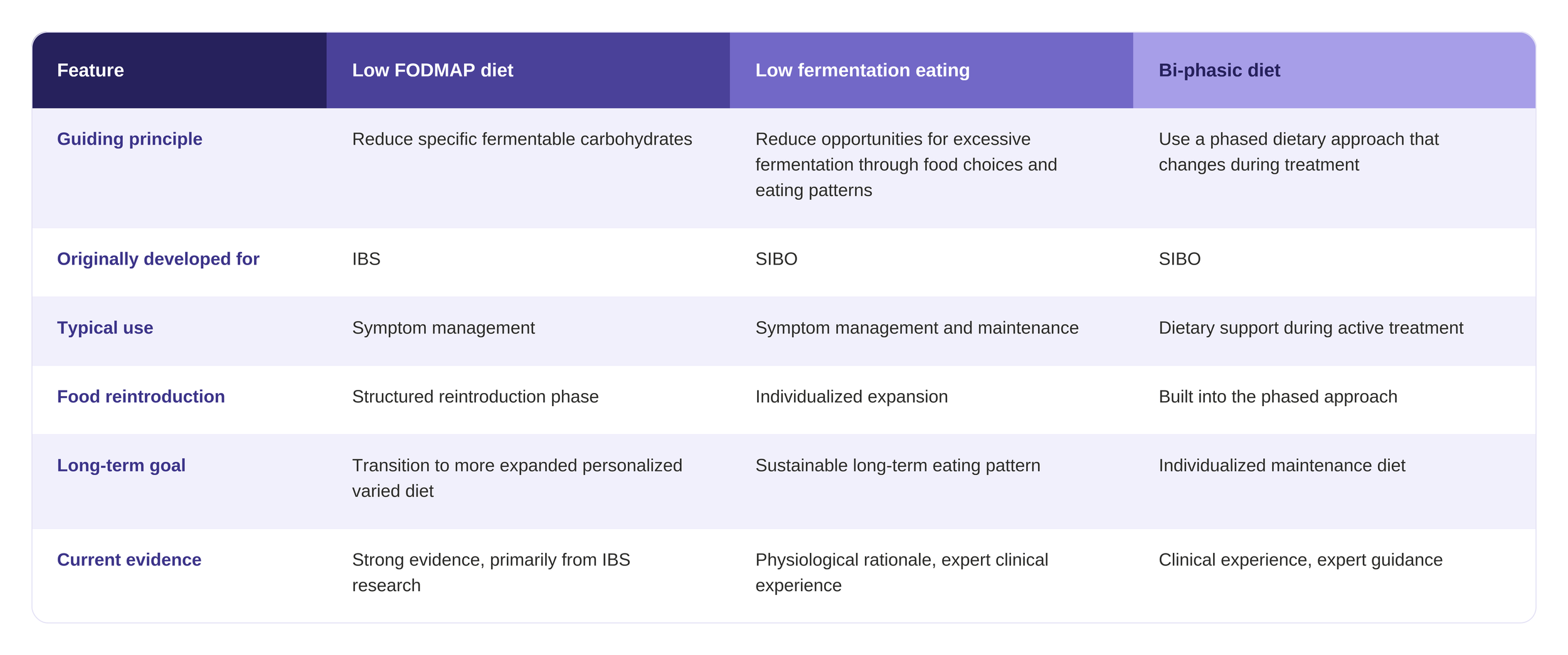
Similarities and differences between SIBO diets
A Closer Look at the Three Dietary Approaches
The Low FODMAP Diet
The Low FODMAP Diet was developed by researchers at Monash University for irritable bowel syndrome (IBS). FODMAPs, or Fermentable Oligosaccharides, Disaccharides, Monosaccharides, and Polyols, are a group of short-chain carbohydrates that are poorly absorbed by some people and readily fermented by gut microbes. By temporarily reducing these carbohydrates, the diet aims to decrease fermentation and relieve symptoms such as bloating, abdominal pain, gas, and changes in bowel habits. It is important to note that the Low FODMAP diet is meant to be a short-term intervention, like an exploration of sensitivities, and not meant for long term use.
Although it was not originally designed specifically for SIBO, the overlap in symptoms and/or diagnosis between IBS and SIBO has led many clinicians to recommend it for people with SIBO. Among dietary approaches, the Low FODMAP Diet has the strongest published evidence for improving gastrointestinal symptoms, although most of this research has been conducted in people with IBS rather than SIBO.
An essential part of the Low FODMAP Diet is food reintroduction. After a short elimination phase, foods are gradually added back to identify individual tolerances and expand the diet. This helps reduce unnecessary food restrictions while supporting adequate nutrition and dietary diversity.
Learn more: Monash University FODMAP Program; My Nutrition Health at University of Michigan
Low Fermentation Eating
Low Fermentation Eating was developed specifically with SIBO in mind. Rather than focusing primarily on one group of carbohydrates, it emphasizes reducing the overall opportunity for excessive fermentation within the small intestine.
This approach considers both what people eat and how they eat. In addition to encouraging foods that are generally well absorbed, Low Fermentation Eating often recommends spacing out meals and limiting unnecessary snacking. These practices are intended to support the migrating motor complex (MMC), the small intestine’s normal housekeeping system that helps move residual food and microbes through the digestive tract between meals. Many clinicians also recommend an overnight fasting period for the same reason.
Compared with the Low FODMAP Diet, Low Fermentation Eating places greater emphasis on digestive physiology and long-term eating habits rather than restricting specific carbohydrate groups. For many people, it serves as a practical maintenance strategy after treatment or once symptoms have improved.
Although research continues to grow, much of the evidence supporting this approach comes from our understanding of digestive physiology, SIBO mechanisms, and clinical experience. More studies are needed to determine which patients benefit most and how this approach compares with other dietary strategies.
Learn more: Good LFE; The Microbiome Connection (Dr. Mark Pimentel and Dr. Ali Rezaie)
The Bi-Phasic Diet
The Bi-Phasic Diet was developed by naturopathic physician Dr. Nirala Jacobi as a structured dietary framework for people undergoing SIBO treatment. It combines principles from the Low FODMAP Diet and the Specific Carbohydrate Diet (SCD) into a phased approach that changes as treatment progresses.
The initial phase temporarily limits foods that may contribute to excessive fermentation (more than just high FODMAP foods). As symptoms improve, foods are gradually reintroduced through a structured progression designed to identify individual tolerances and expand dietary variety.
Like the other approaches described in this article, the Bi-Phasic Diet emphasizes that dietary restriction should not be permanent. The long-term objective is an individualized, nutritionally balanced eating pattern that supports both digestive health and quality of life.
The Bi-Phasic Diet is widely used in integrative and functional medicine practices. While its phased structure reflects many principles found throughout the broader SIBO literature and is supported by extensive clinical experience, additional research is needed to evaluate its effectiveness in formal clinical trials.
Learn more: The Original Bi-Phasic Diet (Dr. Nirala Jacobi); SIBO Academy overview of the Bi-Phasic Diet
Choosing the Right Dietary Approach
No dietary strategy has been shown to be consistently superior for everyone with SIBO, and healthcare providers often individualize recommendations based on a person’s symptoms, nutritional status, medical history, and treatment goals. Clinicians also frequently adapt dietary recommendations over time, combining elements from different approaches as symptoms improve, food tolerances become clearer, and treatment progresses.
The dietary strategy that is most helpful early in treatment may not be the same one that is appropriate months later. For this reason and others, dietary interventions should always be done under the guidance of a provider, particularly when limiting food sources is part of the equation. Your provider is an essential resource to helping understand what elements of a diet to keep and what to adjust.
Although the Low FODMAP Diet, Low Fermentation Eating, and the Bi-Phasic Diet begin from different perspectives, they ultimately share the same destination: helping people manage symptoms while returning to the most varied, nutritious diet they can comfortably tolerate.
Rather than taking extremes like “Which foods can I never eat again?”, a more helpful question is:
“Which dietary approach can help me return to tolerating the widest variety of foods?”
The Takeaway
The Low FODMAP Diet, Low Fermentation Eating, and the Bi-Phasic Diet each offer a different framework for managing symptoms associated with SIBO. While they differ in their guiding principles, they all recognize that dietary management should be individualized and integrated into a broader treatment plan.
As research continues to evolve, dietary recommendations will likely become even more personalized. Until then, understanding the principles behind each approach can help you have more informed conversations with your healthcare team and choose a strategy that fits your symptoms, nutritional needs, lifestyle, and stage of treatment.
The goal is to find the least limiting approach that helps you feel well while supporting long-term nutrition and quality of life.
Key References
Gibson, P. R., Halmos, E. P., & Muir, J. G. (2020). Review article: FODMAPs, prebiotics and gut health—The FODMAP hypothesis revisited. Alimentary Pharmacology & Therapeutics, 52(2), 233–246. https://doi.org/10.1111/apt.15818
Gibson, P. R., & Shepherd, S. J. (2010). Evidence-based dietary management of functional gastrointestinal symptoms: The FODMAP approach. Journal of Gastroenterology and Hepatology, 25(2), 252–258. https://doi.org/10.1111/j.1440-1746.2009.06149.x
Good LFE. (n.d.). Low Fermentation Eating. https://goodlfe.com/
Jacobi, N. (n.d.). The Bi-Phasic Diet. The SIBO Doctor. https://www.thesibodoctor.com/
Monash University. (n.d.). The Monash FODMAP diet. https://www.monashfodmap.com/
Pimentel, M., Saad, R. J., Long, M. D., & Rao, S. S. C. (2020). ACG Clinical Guideline: Small intestinal bacterial overgrowth. The American Journal of Gastroenterology, 115(2), 165–178. https://doi.org/10.14309/ajg.0000000000000501
Quigley, E. M. M. (2019). The spectrum of small intestinal bacterial overgrowth (SIBO). Current Gastroenterology Reports, 21(1), Article 3. https://doi.org/10.1007/s11894-019-0681-6
Redondo-Cuevas, L., Castillo, A. R. L., Nicolás, Á., Martín-Carbonell, V., Sanchis, L., Olivares, A., et al. (2024). The addition of herbal supplements, probiotics, and other natural products to standard treatment in patients with small intestinal bacterial overgrowth: A real-world study. Nutrients, 16, 1083. https://doi.org/10.3390/nu16071083
Rezaie, A., Buresi, M., Lembo, A., Lin, H., McCallum, R., Rao, S., Schmulson, M., Sharma, A., Zakko, S., & Pimentel, M. (2017). Hydrogen and methane-based breath testing in gastrointestinal disorders: The North American Consensus. The American Journal of Gastroenterology, 112(5), 775–784. https://doi.org/10.1038/ajg.2017.46
Velasco-Aburto, S., Llama-Palacios, A., Sánchez, M. C., Ciudad, M. J., & Collado, L. (2025). Nutritional approach to small intestinal bacterial overgrowth: A narrative review. Nutrients, 17, 1410. https://doi.org/10.3390/nu17091410
Wilk, K., Witkowska, E., Ciechański, M., Cholewiński, S., Wilk, B., Stachura, P., Rejman, P., Pszczoła, K., Jurkiewicz, K., & Kasprzyk, A. (2024). Understanding small intestinal bacterial overgrowth: A comprehensive review.