
Fermented Foods and Gut Fermentation: What Is the Difference?

Key Takeaways
Fermented foods and gut fermentation are two different things: one happens outside the body before you eat, while the other happens inside your digestive tract afterward.
Not all fermented foods are probiotic foods, and the ingredient list may matter more than the “fermented” or “gut-friendly” label on the front.
For people with SIBO, the key issue is location: symptoms can arise when excessive fermentation occurs in the small intestine, rather than primarily in the colon.
Fermentation in Our Food
Fermentation is one of the most common words in gut health. It appears in discussions about yogurt, kimchi, kombucha, probiotics, the microbiome, and even small intestinal bacterial overgrowth (SIBO). That basic biology of fermentation is similar whether it takes place in a jar of sauerkraut or in the human colon. What differs is why it happens and what it means for health.
Put simply, fermentation is the process by which microorganisms such as bacteria and yeast break down carbohydrates into other compounds.
When we talk about fermented foods, we are referring to foods that have already been changed by microbes before you eat them. Humans have intentionally fermented foods for thousands of years to preserve them, improve their flavor and texture, and, in some cases, enhance digestibility. Familiar examples include:
Yogurt and kefir, made from fermented dairy
Sauerkraut and kimchi, made from fermented vegetables
Sourdough, made from fermented grain
Kombucha, made from fermented tea
Miso and tempeh, made from fermented soy
In each case microorganisms feed on sugars and other components in the milk, cabbage, or soy. In the process, they produce compounds such as lactic acid, carbon dioxide, or alcohol. This changes the food’s flavor, texture, and shelf life, and may also affect how it is digested.
For example, the cultures used to produce yogurt break down some of its lactose. This is one reason some people who have trouble digesting lactose tolerate yogurt better than unfermented milk.
Fermentation in Our Gut
Gut fermentation is an internal process that happens after you eat. It occurs when microorganisms living in the digestive tract break down carbohydrates and fibers that have not been fully digested or absorbed by the body.
Under normal circumstances, digestive enzymes break down and help absorb most simple sugars and starches in the upper digestive tract. Fibers, resistant starches, and some other carbohydrates continue into the colon, which contains the gut’s densest microbial community. Colonic fermentation is one of the microbiome’s most important metabolic functions, converting dietary components that human enzymes cannot fully digest into compounds the body can use.
When fermentation occurs primarily in the colon, it is a normal and beneficial part of digestion that supports the gut microbiome, nourishes the cells lining the intestine, and contributes to overall digestive health
How Are Fermented Foods and Gut Fermentation Related?
The two processes both involve microorganisms, but they do not necessarily go hand in hand. Eating a fermented food does not mean that the fermentation used to produce that food simply continues inside your digestive tract. Likewise, normal gut fermentation occurs whether or not a person regularly eats fermented foods.
Fermentation in a jar of sauerkraut and fermentation in the colon perform different functions and often involve different microbial communities. Now that we’ve clarified how these processes are separate, let’s dive into gut fermentation – when we want it, and when we want to limit it.
Where Should Gut Fermentation Happen?
This distinction is especially important for people with SIBO.
In a healthy digestive system, the number of microbes and their activity differ substantially along the gastrointestinal tract. The colon contains the largest microbial community and is the primary site of extensive carbohydrate fermentation.
The colon is one of the most densely populated microbial environments in the body, containing hundreds of billions to trillions of microorganisms. In contrast, the healthy small intestine contains roughly a billion times fewer microorganisms. This difference is not accidental. Several defense mechanisms work together to keep bacterial numbers low in the small intestine, including stomach acid, bile and pancreatic secretions, the migrating motor complex, and immune defenses.
Microorganisms are not simply “good” or “bad.” Their effects also depend on how many are present, what they are producing, and where in the digestive tract they are located.
In SIBO, excessive numbers or altered populations of bacteria are present in the small intestine. These microorganisms may gain early access to carbohydrates and ferment them before the food reaches the colon, producing gas and other microbial metabolites within the small intestine. Gas accumulation and distension may contribute to immediate symptoms, including:
Bloating and visible abdominal distension
Abdominal discomfort, pain, or cramping
Diarrhea, constipation, or alternating bowel habits
Excessive gas or belching
Bacterial activity in the small intestine may also interfere with digestion and nutrient absorption in some patients, particularly when overgrowth is substantial or persistent.
Seen this way, SIBO is not simply a problem of “not enough good bacteria.” It is more accurately understood as a problem involving microorganisms performing an ordinarily useful function in the wrong place, in excessive numbers, or at the wrong time.
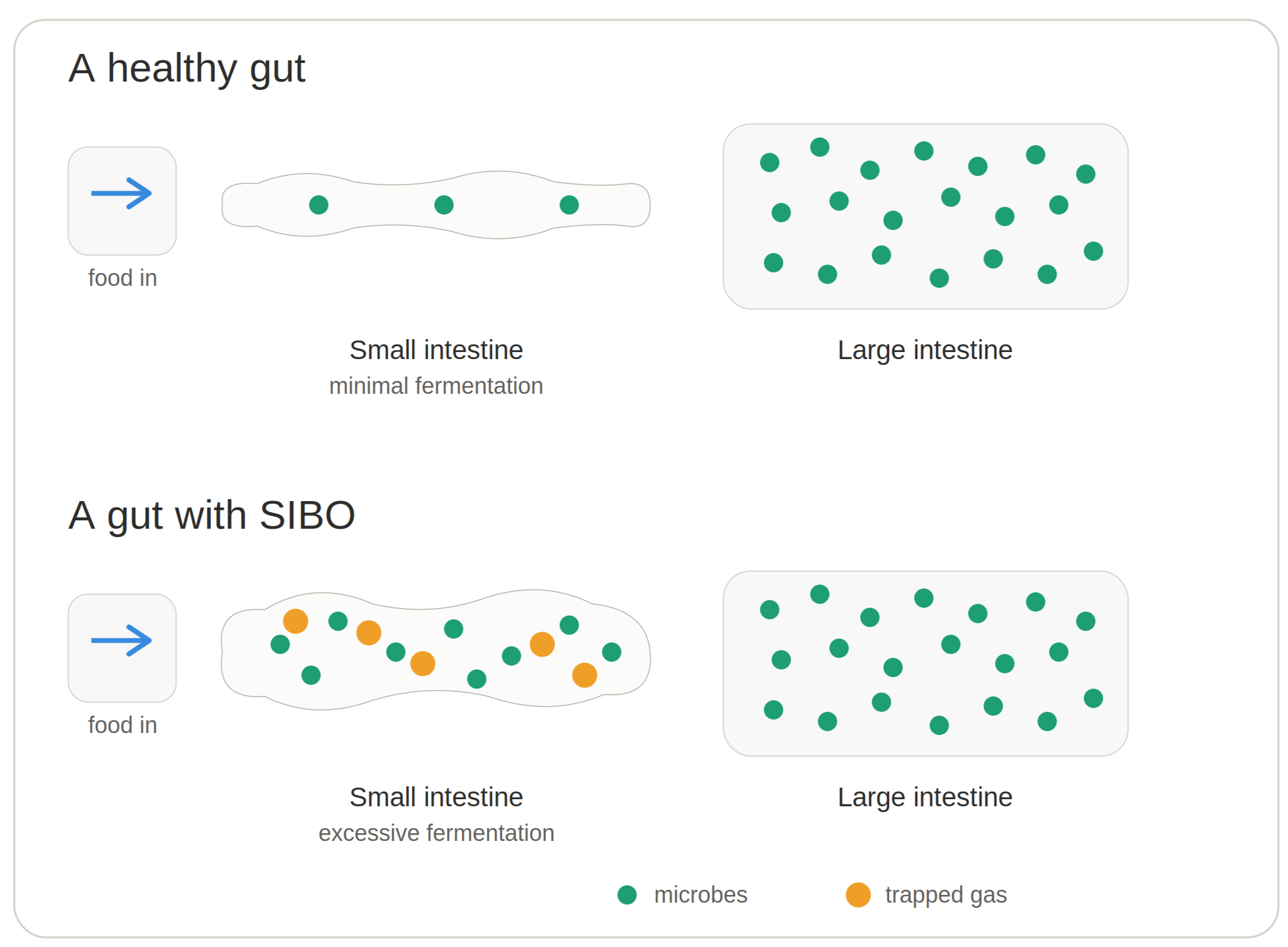
Fermentation as it takes place in the digestive system.
Are Fermented Foods Good or Bad for SIBO?
Fermentation changes different foods in different ways. As a result, one fermented food may be tolerated very differently from another. Their suitability also depends on a person’s symptoms and their stage of treatment.
For example:
Sourdough: During traditional sourdough production, yeasts and lactic acid bacteria can break down some fermentable carbohydrates in flour. Research and food testing indicate that certain traditionally fermented sourdough breads may contain fewer FODMAPs than rapidly produced breads, although this depends on the flour, microbial cultures, fermentation time, and production method. For some people with SIBO, traditionally fermented sourdough bread may therefore be better tolerated than non-fermented bread because some of the fermentation has already taken place before the bread is eaten, leaving fewer fermentable carbohydrates available for microbes in the gut.
Sauerkraut and other fermented vegetables: Fermentation can reduce some sugars while producing or concentrating other fermentable compounds. The amount of fermentable carbohydrates varies depending on the vegetable, fermentation process, serving size, and added ingredients. For people with SIBO, fermented vegetables are therefore not automatically foods to avoid. Instead, tolerance depends on the specific product, the amount eaten, and your individual response.
The central takeaway is that tolerance is individual. When dealing with SIBO, one fermented food may be well tolerated, while another may produce symptoms because of its carbohydrate content, histamine level, ingredients, carbonation, acidity, or serving size.
Questions Worth Bringing to Your Clinician
The role of fermented foods in a SIBO eating plan is individual. It may help to discuss questions such as these with a physician or registered dietitian who understands your medical history:
What is an appropriate serving size for me?
Does my tolerance change between a small and a larger serving?
Is this an appropriate time to test the food based on current symptoms and treatment?
Tolerance to fermented foods can vary widely and may also change during treatment. Working with a qualified clinician or dietitian can help determine whether, when, and in what amount a particular fermented food belongs in an individual eating plan.
The Takeaway
Fermented foods and gut fermentation share a name and some basic biology, but they are not the same process. One occurs before food is eaten; the other takes place within the digestive tract.
Food fermentation can produce flavorful and nutritious foods, while fermentation in the colon helps the microbiome convert dietary fiber into products the body can use. In SIBO, problems may arise when excessive fermentation occurs too early and too high in the digestive tract.
Understanding this distinction helps move the conversation beyond simple lists of “good” and “bad” foods. Instead, it highlights a more important question: Where is fermentation happening, and is it happening where it should?
For people with SIBO, the fermentation is happening in the small intestine, instead of the large intestine where it is intended to take place. This is central to understanding SIBO symptoms and making informed, individualized food choices.
Key References
Gobbetti, M., De Angelis, M., Di Cagno, R., Calasso, M., & Archetti, G. (2019). Novel insights on the functional and nutritional features of the sourdough fermentation. International Journal of Food Microbiology, 302, 103–113. https://doi.org/10.1016/j.ijfoodmicro.2018.05.018
Hill, C., Guarner, F., Reid, G., Gibson, G. R., Merenstein, D. J., Pot, B., Morelli, L., Canani, R. B., Flint, H. J., Salminen, S., Calder, P. C., & Sanders, M. E. (2014). Expert consensus document: The International Scientific Association for Probiotics and Prebiotics consensus statement on the scope and appropriate use of the term probiotic. Nature Reviews Gastroenterology & Hepatology, 11(8), 506–514. https://doi.org/10.1038/nrgastro.2014.66
Koh, A., De Vadder, F., Kovatcheva-Datchary, P., & Bäckhed, F. (2016). From dietary fiber to host physiology: Short-chain fatty acids as key bacterial metabolites. Cell, 165(6), 1332–1345. https://doi.org/10.1016/j.cell.2016.05.041
Loponen, J., & Gänzle, M. G. (2018). Use of sourdough in low-FODMAP baking. Foods, 7(7), 96. https://doi.org/10.3390/foods7070096
Macfarlane, G. T., & Macfarlane, S. (2012). Bacteria, colonic fermentation, and gastrointestinal health. Journal of AOAC International, 95(1), 50–60. https://doi.org/10.5740/jaoacint.SGE_Macfarlane
Maintz, L., & Novak, N. (2007). Histamine and histamine intolerance. The American Journal of Clinical Nutrition, 85(5), 1185–1196. https://doi.org/10.1093/ajcn/85.5.1185
Marco, M. L., Sanders, M. E., Gänzle, M., Arrieta, M. C., Cotter, P. D., De Vuyst, L., Hill, C., Holzapfel, W., Lebeer, S., Merenstein, D., Reid, G., Wolfe, B. E., & Hutkins, R. (2021). The International Scientific Association for Probiotics and Prebiotics consensus statement on fermented foods. Nature Reviews Gastroenterology & Hepatology, 18(3), 196–208. https://doi.org/10.1038/s41575-020-00390-5
Monash University. (2017, November 8). Sourdough processing and FODMAPs. Monash FODMAP.
Pimentel, M., Saad, R. J., Long, M. D., & Rao, S. S. C. (2020). ACG clinical guideline: Small intestinal bacterial overgrowth. The American Journal of Gastroenterology, 115(2), 165–178. https://doi.org/10.14309/ajg.0000000000000501
Quigley, E. M. M., & Murray, J. A. (2019). The spectrum of small intestinal bacterial overgrowth. Current Gastroenterology Reports, 21, 3. https://doi.org/10.1007/s11894-019-0671-z
Rezaie, A., & Rao, S. S. C. (2023). Intestinal bacterial, fungal, and methanogen overgrowth. In S. S. C. Rao, H. P. Parkman, & R. W. McCallum (Eds.), Handbook of gastrointestinal motility and disorders of gut-brain interactions (2nd ed., pp. 205–221). Academic Press.
Savaiano, D. A. (2014). Lactose digestion from yogurt: Mechanism and relevance. The American Journal of Clinical Nutrition, 99(5), 1251S–1255S. https://doi.org/10.3945/ajcn.113.073023
Wastyk, H. C., Fragiadakis, G. K., Perelman, D., Dahan, D., Merrill, B. D., Yu, F. B., Topf, M., Gonzalez, C. G., Van Treuren, W., Han, S., Robinson, J. L., Elias, J. E., Sonnenburg, E. D., Gardner, C. D., & Sonnenburg, J. L. (2021). Gut-microbiota-targeted diets modulate human immune status. Cell, 184(16), 4137–4153.e14. https://doi.org/10.1016/j.cell.2021.06.019