
Sugar and SIBO: Why Not All Sweeteners Are Created Equal

Key Takeaways
Not all sugars affect SIBO symptoms equally. Poorly absorbed sugars and sugar alcohols are more likely to contribute to gas and bloating.
“Sugar-free” treats often contain sugar alcohols such as sorbitol, maltitol, or xylitol, which may cause more digestive symptoms than small amounts of regular sugar.
Individual tolerance varies, making moderation and tracking symptoms more useful than following overly restrictive rules.
It’s the holiday season, which means Halloween candy bowls, work potlucks, and holiday desserts. For people with small intestine bacterial overgrowth (SIBO), navigating a season built around sugar can be challenging because certain sugars can contribute to digestive symptoms like bloating, gas, and abdominal discomfort. But saying no to sweets is not always possible, or even desired. The good news? Not all sugars trigger SIBO symptoms equally.
In this article, we explore how different sugars and sugar alcohols affect digestion, which ones are more likely to trigger SIBO symptoms, and practical tips for indulging your sweet tooth while still managing your symptoms.
Why Does Sugar Affect SIBO Symptoms?
When the sugars we eat are not fully absorbed or digested, gut bacteria break them down through a process called fermentation. For people without SIBO, most of this fermentation takes place in the large intestine where most gut bacteria live. For people with SIBO, excess bacteria in the small intestine can ferment these sugars earlier in the digestive process. This produces gases that contribute to SIBO symptoms such as bloating, abdominal distension, gas, and changes in bowel movements.
However, not all sugars behave the same way in the digestive tract. Some, such as glucose, are easily absorbed, leaving relatively little available for bacteria to ferment. Others, including fructose, lactose, and sugar alcohols, may be poorly absorbed. These belong to a group of carbohydrates called FODMAPs. Because FODMAPs are poorly absorbed or cannot be fully digested, they can provide more material for bacterial fermentation. This is why some people with SIBO find that reducing high-FODMAP foods helps ease their symptoms.
Can Dietary Changes Help Reduce SIBO Symptoms?
For people with SIBO, the goal is not necessarily to avoid sugar altogether but to understand which sugars and sweeteners are more likely to trigger symptoms. Reducing fermentable sugars may help manage symptoms by limiting the amount of material for bacteria to ferment. This may involve limiting certain poorly absorbed carbohydrates, including sugar alcohols and other high-FODMAP ingredients, depending on individual tolerance.
Two dietary approaches commonly used to manage digestive symptoms are the Low FODMAP diet and Low Fermentation Eating. The Low FODMAP diet has been shown to support symptom relief, particularly for IBS. But it can be restrictive and is intended to include a gradual reintroduction of foods. Low Fermentation Eating offers a less restrictive approach that may be easier to maintain over time, helping patients build a lifestyle that is more balanced.
Check out our article on Which SIBO Diet is Which? to learn more about these different diets.
Why Sugar Free Doesn’t Always Mean SIBO-Friendly
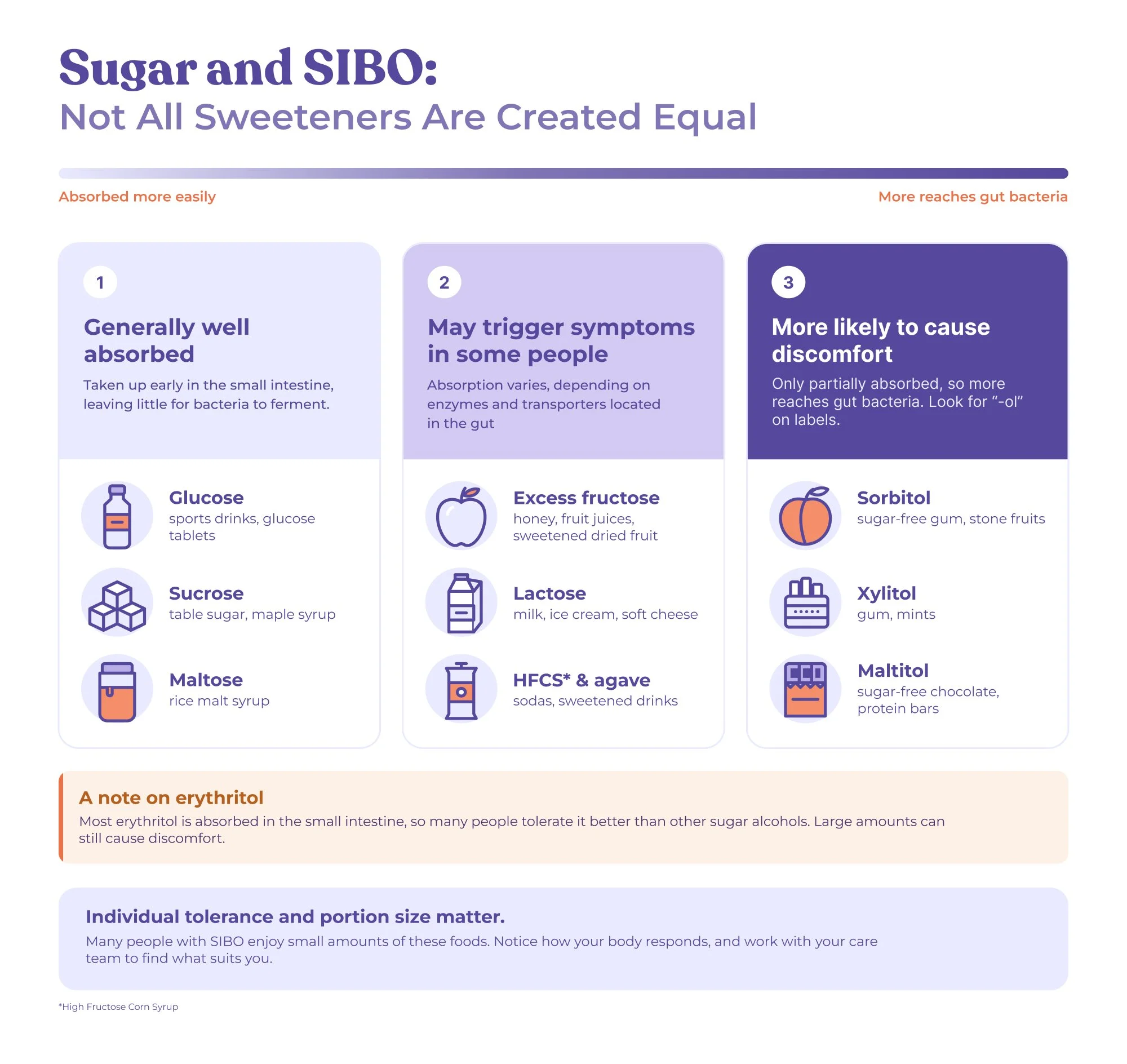
With Halloween approaching, “sugar-free” candy options may be tempting as the safer option, but for SIBO, this can backfire. Many sugar-free candies replace sugar with sugar alcohols like sorbitol, mannitol, xylitol, erythritol, or maltitol. Unlike regular table sugar, these sweeteners are often incompletely absorbed, allowing more of them to reach the gut bacteria where they can be fermented. Erythritol is an exception: most of it is absorbed before it reaches gut bacteria, so some people tolerate it better, although large amounts can still cause symptoms.
The guide below can help you evaluate the ingredients you might come across in different sweets.
5 Tips for Enjoying Sweets while Managing SIBO
1. Read ingredient labels: Look for sugar alcohols (often ending in "-ol") on the ingredient list, such as sorbitol, mannitol, xylitol, and maltitol.
2. Keep to small portions of sugary treats: When deciding on a treat, keep in mind that a smaller portion of regular sugar is often easier to tolerate than a larger portion of “sugar-free” sweeteners or sugar alcohols.
3. Avoid constant grazing: Enjoy treats with or right after a balanced meal rather than grazing throughout the day. Meal spacing gives the migrating motor complex, your gut’s cleaning mechanism, time to do its job.
4. Keep a symptom log: Individual tolerance varies significantly from person to person. Keeping brief notes for a week or two can quickly highlight your personal threshold and take the guesswork out of enjoying which foods might trigger symptoms.
5. Focus on moderation over elimination: Frame your strategy around informed, empowered choices rather than strict restriction. Having your own alternative indulgent treat on hand at a gathering can allow you to enjoy the holiday season while still supporting your gut health.
SIBO-Friendly Fall Treats Anyone Could Love
Sticking to your SIBO goals doesn't have mean giving up sweets during the holiday season! Try these delicious recipes from our partner GoodLFE, whose recipe library focuses on low-fermentation, SIBO/IBS-friendly cooking.
Peanut Chews — A sweet and salty candy-style treat that works well in any trick-or-treat bowl.
Pecan & Cinnamon Sticky Buns — A cozy, cinnamon-spiced indulgence perfect for the sharing around the table.
Flourless Chocolate Raspberry Torte — A more elegant chocolate option for holiday hosting or a dessert table.
As always, SIBO tolerance is deeply individual. Understanding how different sugars and sweeteners trigger or worsen SIBO symptoms gives you an empowering tool for navigating seasonal foods with greater comfort and confidence. If your symptoms are significant or you're unsure where your personal thresholds lie, speak with your healthcare provider or dietitian before the season gets into full swing.
Key References
Achufusi, T. G. O., Sharma, A., Zamora, E. A., & Manocha, D. (2020). Small intestinal bacterial overgrowth: Comprehensive review of diagnosis, prevention, and treatment methods. Cureus, 12(6), e8860. https://doi.org/10.7759/cureus.8860
Gibson, P. R., & Shepherd, S. J. (2010). Evidence-based dietary management of functional gastrointestinal symptoms: The FODMAP approach. Journal of Gastroenterology and Hepatology, 25(2), 252–258. https://doi.org/10.1111/j.1440-1746.2009.06149.x
Lenhart, A., & Chey, W. D. (2017). A systematic review of the effects of polyols on gastrointestinal health and irritable bowel syndrome. Advances in Nutrition, 8(4), 587–596. https://doi.org/10.3945/an.117.015560
Mazi, T. A., & Stanhope, K. L. (2023). Erythritol: An in-depth discussion of its potential to be a beneficial dietary component. Nutrients, 15(1), 204. https://doi.org/10.3390/nu15010204
Pimentel, M., Saad, R. J., Long, M. D., & Rao, S. S. C. (2020). ACG clinical guideline: Small intestinal bacterial overgrowth. American Journal of Gastroenterology, 115(2), 165–178. https://doi.org/10.14309/ajg.0000000000000501
Velasco-Aburto, S., Llama-Palacios, A., Sánchez, M. C., Ciudad, M. J., & Collado, L. (2025). Nutritional approach to small intestinal bacterial overgrowth: A narrative review. Nutrients, 17(9), 1410. https://doi.org/10.3390/nu17091410